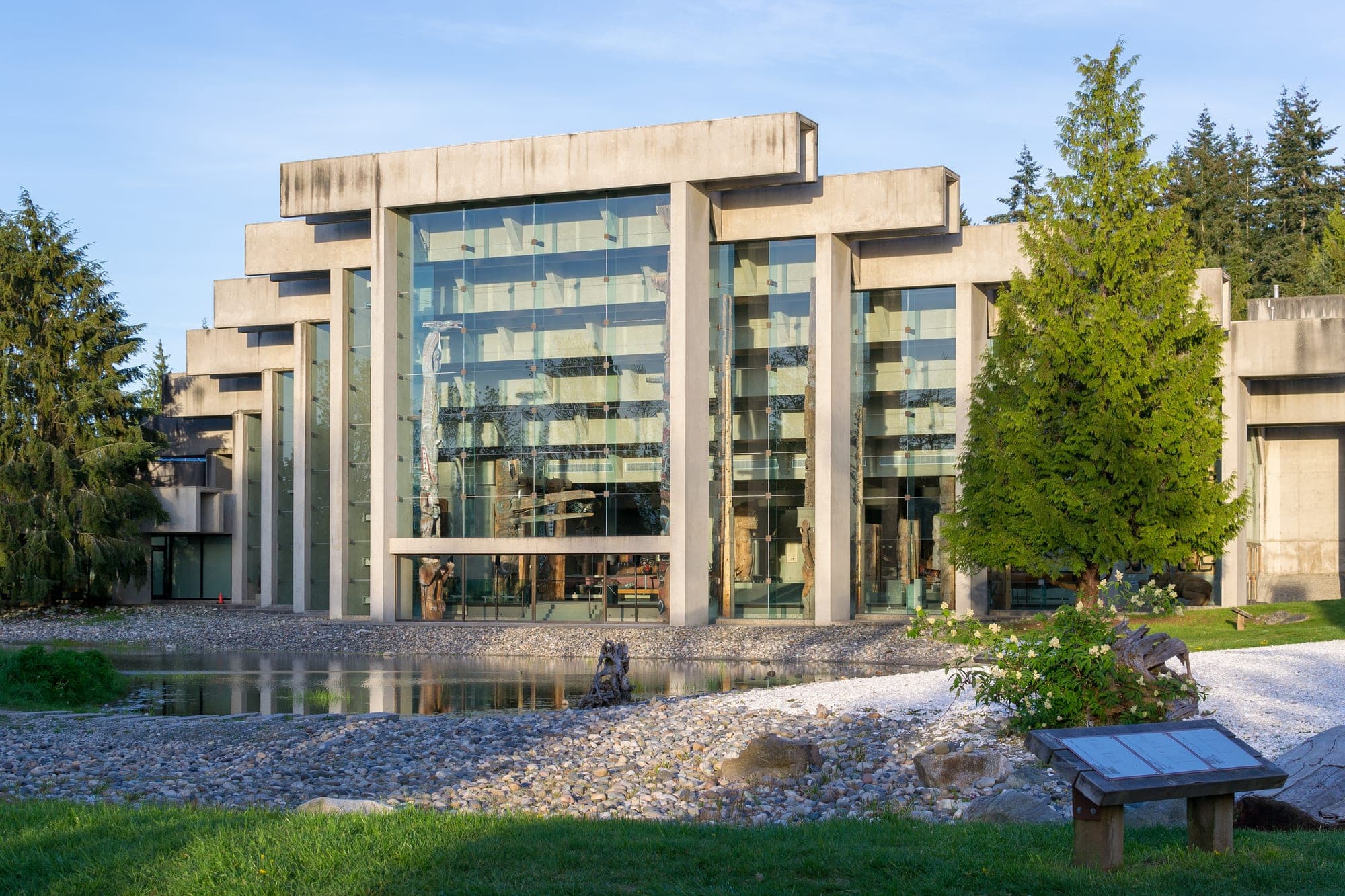
The Museum of Anthropology at UBC — MOA to everyone in Vancouver — sits on a grassy bluff at the western tip of the Point Grey peninsula, with views over Howe Sound to the North Shore mountains. The building itself is a work of art: Arthur Erickson designed it in 1976, using reinforced concrete and massive glass walls to echo the post-and-beam construction of Northwest Coast longhouses. The Great Hall, where the largest totem poles and Bill Reid carvings are displayed, is a vertical glass volume that frames the exterior forest and ocean as part of the exhibit.
The collection is one of the most important repositories of Northwest Coast Indigenous art anywhere in the world — Haida, Kwakwaka'wakw, Nuu-chah-nulth, Salish, and other peoples' works, many repatriated or contributed directly by the nations themselves. Bill Reid's monumental yellow cedar sculpture "The Raven and the First Men" is the most famous single piece in the collection. The Multiversity Galleries allow visitors to browse the museum's entire reserve collection — tens of thousands of objects in visible storage.
Outside the main building, the Haida House complex on the grass slopes recreates a traditional longhouse with several massive totem poles and mortuary poles. Give yourself at least two hours, plus time for the walk from the parking lot.
MOA is the single best museum in Western Canada for understanding Indigenous art of the Pacific Northwest, and one of the top cultural attractions in Vancouver period. Thursday evenings are half-price, which is the smart time to go.
How to get there
The 4 UBC or 14 UBC buses run from downtown via Granville Street; get off at the UBC Bus Exchange and walk 10 minutes. The 99 B-Line from Commercial–Broadway is faster. Parking on campus is paid and often full on weekends.
Local tips
- Thursday evenings are half-price — the best time to visit
- Allow at least 2–3 hours
- Don't miss the outdoor Haida House complex behind the main building
- Combine with Nitobe Memorial Garden next door on the same UBC visit